A restraining order in California can last anywhere from five days to the rest of your life, depending on the type of order that was issued. There is no single answer. California law authorizes four different types of protective orders in domestic violence cases, each with its own duration, its own legal standard, and its own procedural rules.
The short version: an Emergency Protective Order lasts five to seven days. A Temporary Restraining Order lasts roughly three weeks. A Domestic Violence Restraining Order can last up to five years and can be renewed permanently. A Criminal Protective Order can last up to ten or fifteen years after a conviction.
Which one applies to your situation — and what you can do about it — is what this page covers.
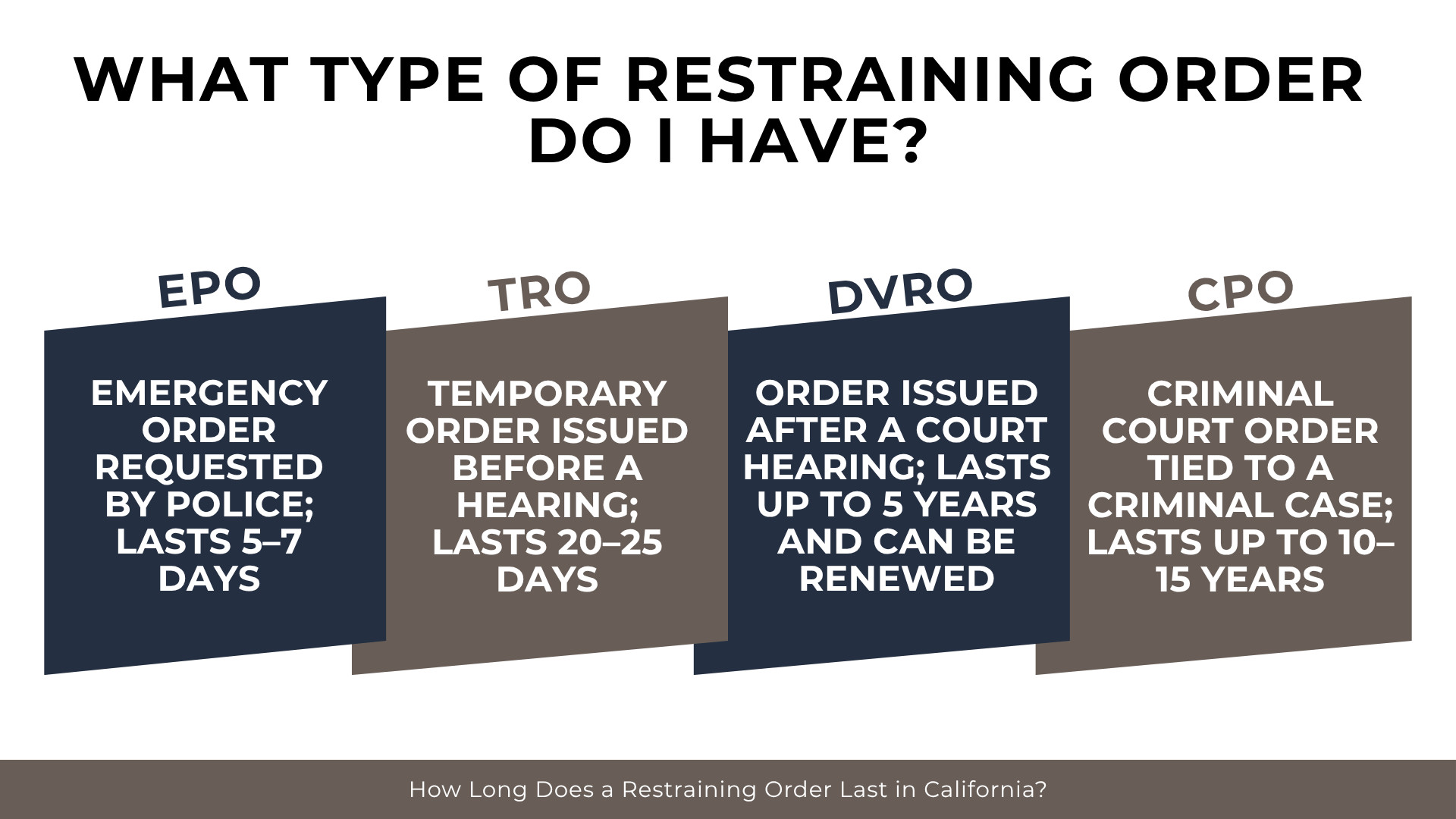
What Type of Restraining Order Do I Have?
Before the duration question has a useful answer, you need to identify what you’re actually dealing with. California issues four kinds of protective orders in domestic violence cases, and they come from different courts, get initiated by different people, and operate on completely different timelines.
An Emergency Protective Order (EPO) is requested by law enforcement and issued by a judge, often the same day as a police response. A Temporary Restraining Order (TRO) is filed by an individual in family court and issued without advance notice to the other party. A Domestic Violence Restraining Order (DVRO) is issued by a family court judge after a hearing where both sides have the opportunity to appear. A Criminal Protective Order (CPO) is issued by a criminal court judge tied to a pending criminal case or as part of sentencing.
The paperwork you received should identify which type of order it is. If you’re unsure, that’s the first question to bring to an attorney. The type of order controls how long it lasts and what options exist to challenge it.
| Order Type | Typical Duration | Who Initiates It |
| Emergency Protective Order (EPO) | 5–7 days | Law enforcement |
| Temporary Restraining Order (TRO) | 20–25 days (until hearing) | The petitioner (civil court) |
| Domestic Violence Restraining Order (DVRO) | Up to 5 years; renewable permanently | Family court judge after hearing |
| Criminal Protective Order (CPO) | Up to 10 years (up to 15 for certain convictions) | Criminal court judge |
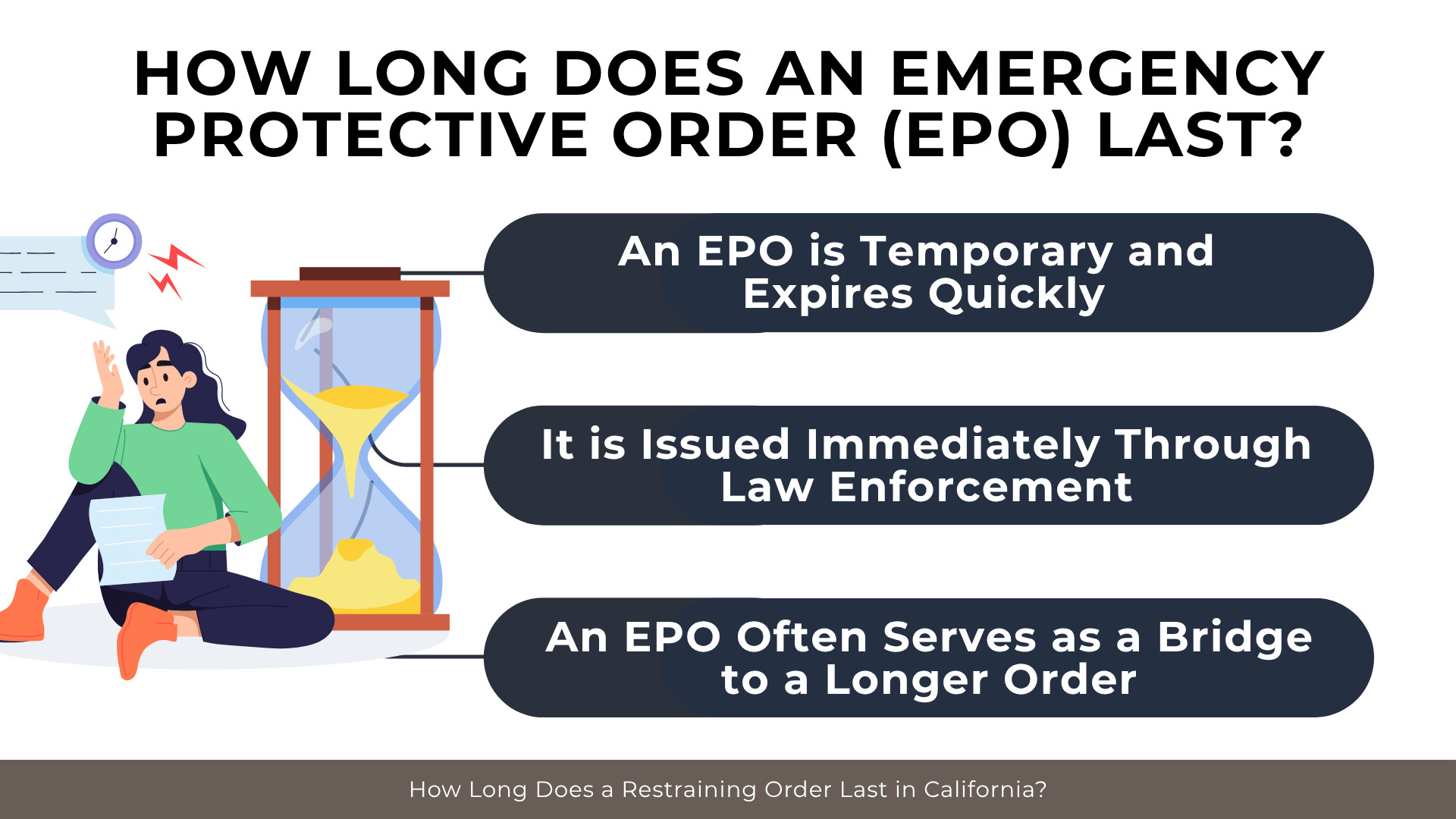
How Long Does an Emergency Protective Order (EPO) Last?
An EPO is the shortest-lived protective order in California. Under California Family Code § 6256, it expires at the earlier of the close of business on the fifth court day following issuance or the seventh calendar day after issuance — whichever comes first.
Only a law enforcement officer can request an EPO. Under Family Code § 6251(a), a designated judicial officer issues the order when law enforcement states reasonable grounds to believe that an immediate and present danger of domestic violence exists. Judges are available for this purpose at all times, whether or not the court is in session (Family Code § 6241). You have no opportunity to be heard before it takes effect. The person seeking protection cannot obtain an EPO on their own — it flows entirely through law enforcement.
The critical thing to understand about an EPO is that its expiration does not necessarily mean the restrictions disappear. The five-to-seven-day window often serves as a bridge. It gives the other party time to file for a Temporary Restraining Order in family court, which carries a longer timeline and can lead to a years-long order. An EPO ending without a TRO being filed is the best-case scenario. An EPO followed by a TRO filing means the process is just beginning.
One additional detail worth knowing: when an EPO is active, it is enforced above all other protective orders under California Penal Code § 136.2(c)(1)(A), provided it meets certain statutory requirements.
How Long Does a Temporary Restraining Order (TRO) Last?
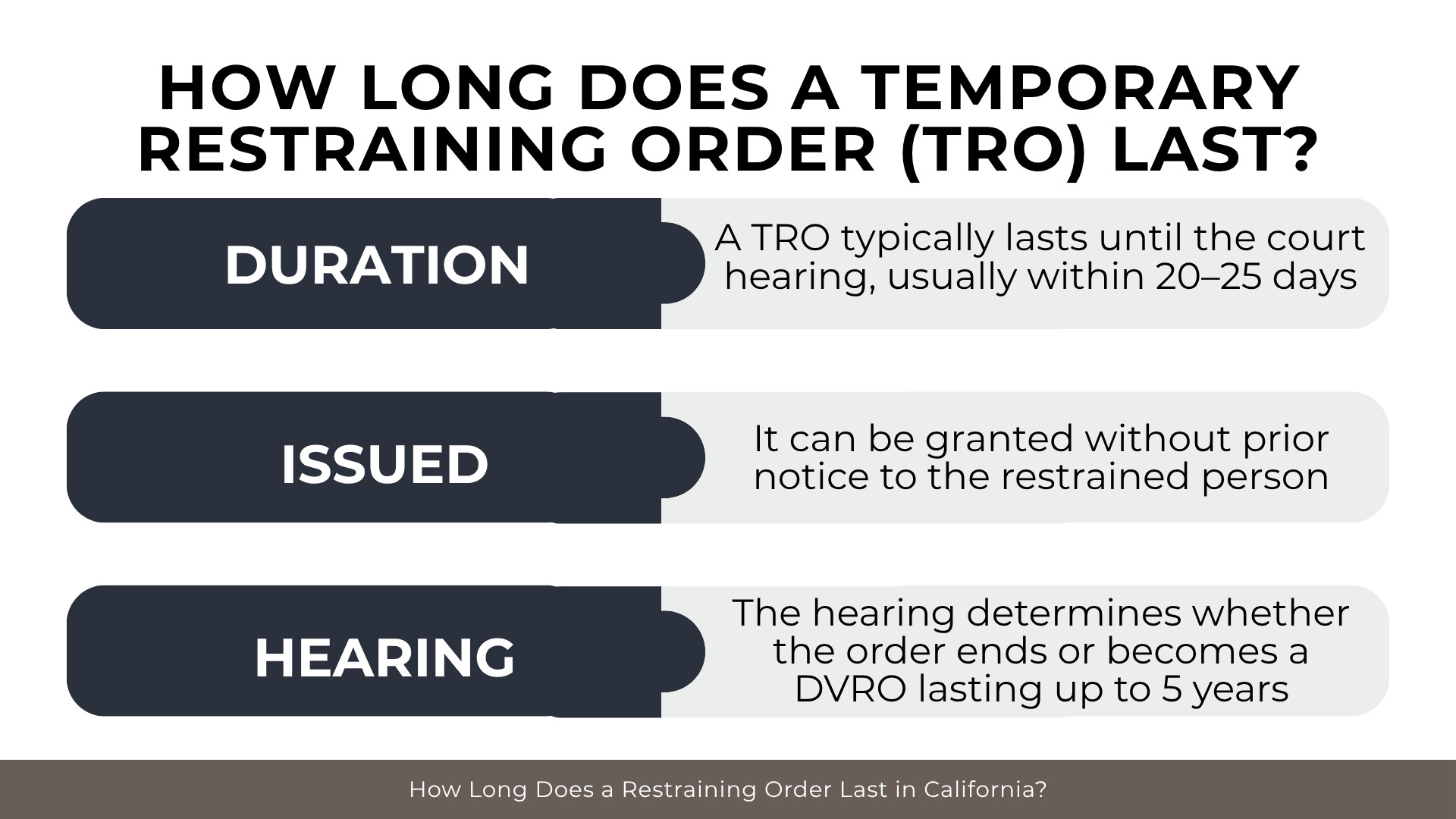
A TRO lasts until the court holds a hearing on whether to grant a longer-term order. That hearing is typically scheduled within 20 to 25 calendar days of the TRO being issued.
Under California Family Code § 6300, a TRO can be issued based on reasonable proof of a past act or acts of abuse. It explicitly cannot be denied solely because the other party was not provided with notice. That means a TRO may have been granted without you knowing it was requested, without you having any chance to tell your side, and without the court hearing any evidence from you. If the court denies a TRO request, it must state its reasons under Family Code § 6320.5. But when one is granted, you typically learn about it only when you are served.
The 20-to-25-day window before the hearing is not just a waiting period. It is the most important window in the entire restraining order timeline, because what happens at that hearing determines whether the restrictions last a few more weeks or up to five years. Showing up without preparation or not showing up at all can result in the TRO converting into a long-term DVRO by default.
How Long Does a Domestic Violence Restraining Order (DVRO) Last?
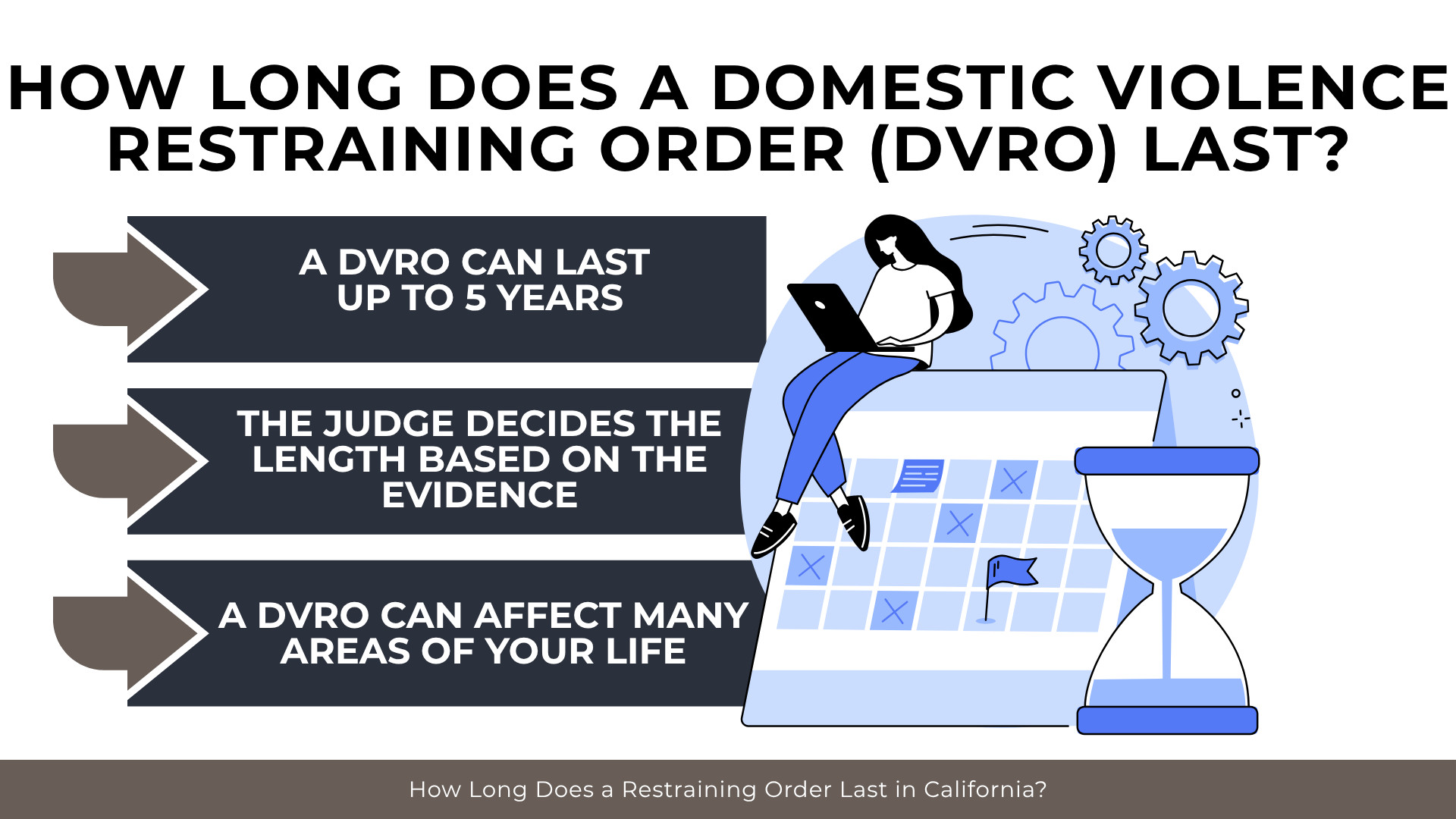
A DVRO can last up to five years under California Family Code § 6345(a). This is the order that gets issued after the noticed hearing — the one where both sides have the opportunity to appear, present evidence, and argue their case.
California courts issue tens of thousands of these orders annually. DVRO filings in California Superior Courts reached 74,223 in FY 2021–22, partially recovering from a pandemic-era drop, after peaking above 83,000 in FY 2017–18.
The standard of proof for a DVRO is preponderance of the evidence — meaning the judge must find it more likely than not that abuse occurred. “Abuse” under Family Code § 6203 is defined broadly. It includes intentionally or recklessly causing or attempting to cause bodily injury, sexual assault, placing a person in reasonable apprehension of imminent serious bodily injury, or engaging in behavior that could be prohibited under Family Code § 6320. Abuse under the statute is not limited to the actual infliction of physical injury or assault.
A DVRO can include orders far beyond a simple stay-away requirement. The court has authority to issue residence exclusion orders (Family Code § 6321), temporary child custody orders (Family Code § 6323), child support orders (Family Code § 3044), spousal support orders (Family Code § 4325), property control orders (Family Code § 6324), and firearms prohibitions (Family Code § 6389). The scope of what a DVRO controls in your daily life — where you live, whether you see your children, who possesses shared property — is why the hearing matters so much.
The five-year maximum is not automatic. A judge decides the duration based on the facts presented. A defense attorney can argue for a shorter term or fight the issuance of the order entirely.
Can a Restraining Order Be Extended or Made Permanent?
Yes. This is the part of California’s restraining order system that catches many people off guard.
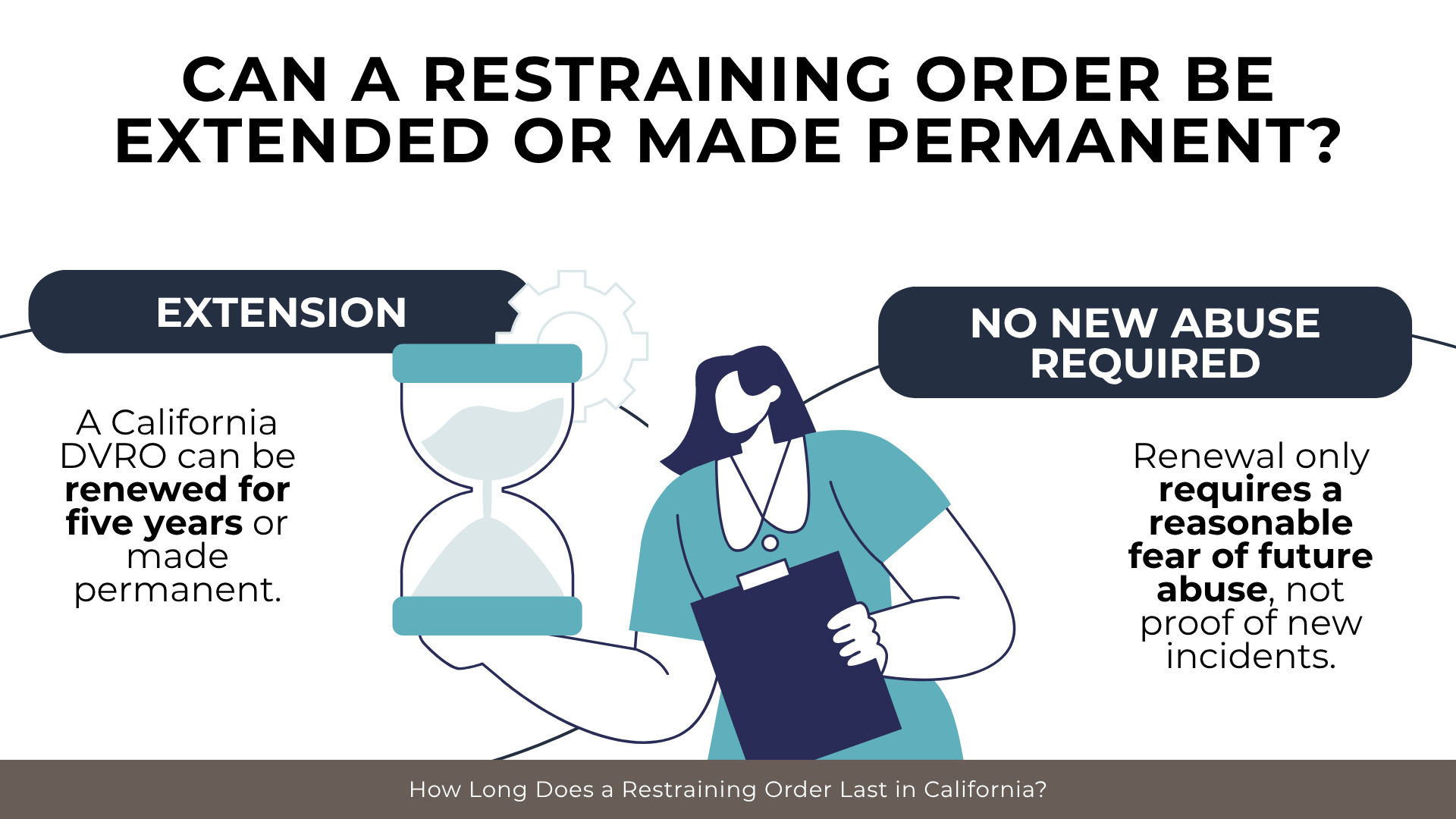
Under Family Code § 6345(a), a DVRO can be renewed for five or more years, or permanently. The standard for renewal does not require the protected party to prove that new abuse occurred after the original order was issued. In Ritchie v. Konrad (2004), the California Court of Appeal held that a trial court should renew a DVRO if it finds by a preponderance of the evidence that the protected party has a reasonable apprehension of future abuse. The petitioner does not need to show any new acts of abuse since the original order — only that the apprehension of future abuse remains reasonable.
What this means in practical terms is that a five-year DVRO issued today can become a ten-year order, a fifteen-year order, or a permanent order through repeated renewals, without any new incident ever occurring. The original behavior that supported the first order can continue to be used to support renewals indefinitely, as long as the court finds the apprehension of future abuse is reasonable.
This is one of the strongest reasons to take the initial DVRO hearing seriously. The evidentiary record created at that hearing — and the court’s findings — can follow you for years or decades through the renewal process.
How Long Does a Criminal Protective Order Last?
If there is a pending criminal case, the restraining order may not be coming from family court at all. Criminal courts issue their own protective orders under California Penal Code § 136.2, and these operate on a separate and often longer timeline.
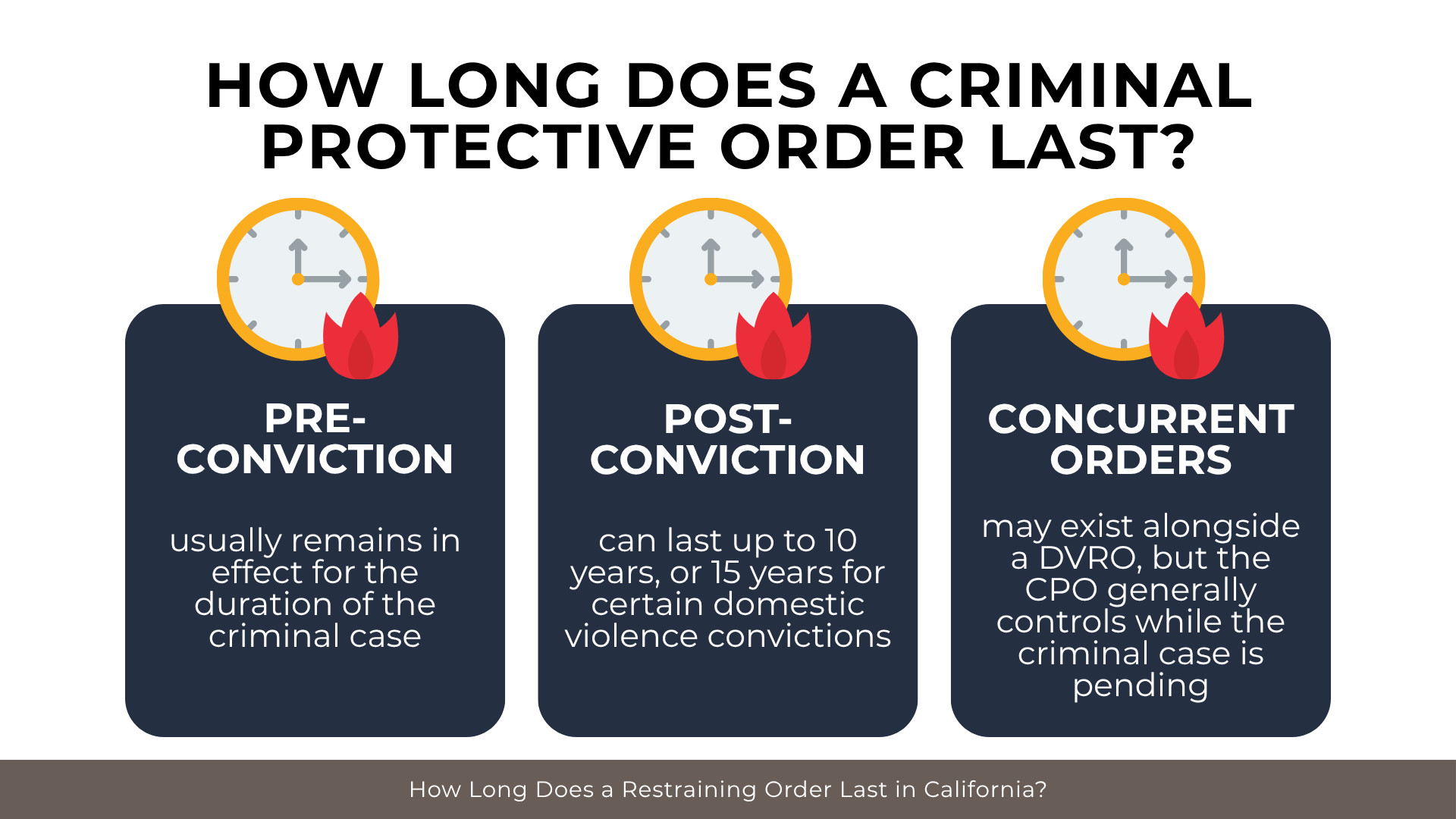
Before a conviction, a criminal court can issue a CPO based on a good cause belief that harm to, or intimidation or dissuasion of, a victim or witness has occurred or is reasonably likely to occur (Penal Code § 136.2(a)(1)). This pretrial CPO stays in effect throughout the criminal case, which in felony matters can take months or longer to resolve.
After a conviction, the stakes increase significantly. Under Penal Code § 136.2(i)(1), a post-conviction CPO can last up to ten years as determined by the court. For convictions involving willful infliction of corporal injury under Penal Code § 273.5, that ceiling rises to fifteen years (Penal Code § 273.5(j)).
Protective orders are issued against roughly 47% of domestic violence aggravated assault defendants who are granted pretrial release, showing how common these orders are in criminal DV cases.
You can be subject to both a CPO and a DVRO at the same time. When both exist, the CPO controls in case of conflict while the criminal case is pending (Penal Code § 136.2(e)(2)), except that an EPO still takes priority (Penal Code § 136.2(c)(1)(B)). The DVRO remains valuable alongside it because it provides remedies unavailable through a CPO, including custody, support, and property orders. It can also be renewed permanently, whereas a CPO has a fixed expiration.
If you are facing both a criminal case and a civil restraining order proceeding, you are dealing with two separate legal tracks, two separate courts, and two separate restraining order timelines. Coordinating a defense across both requires an attorney who understands how decisions in one proceeding affect the other.
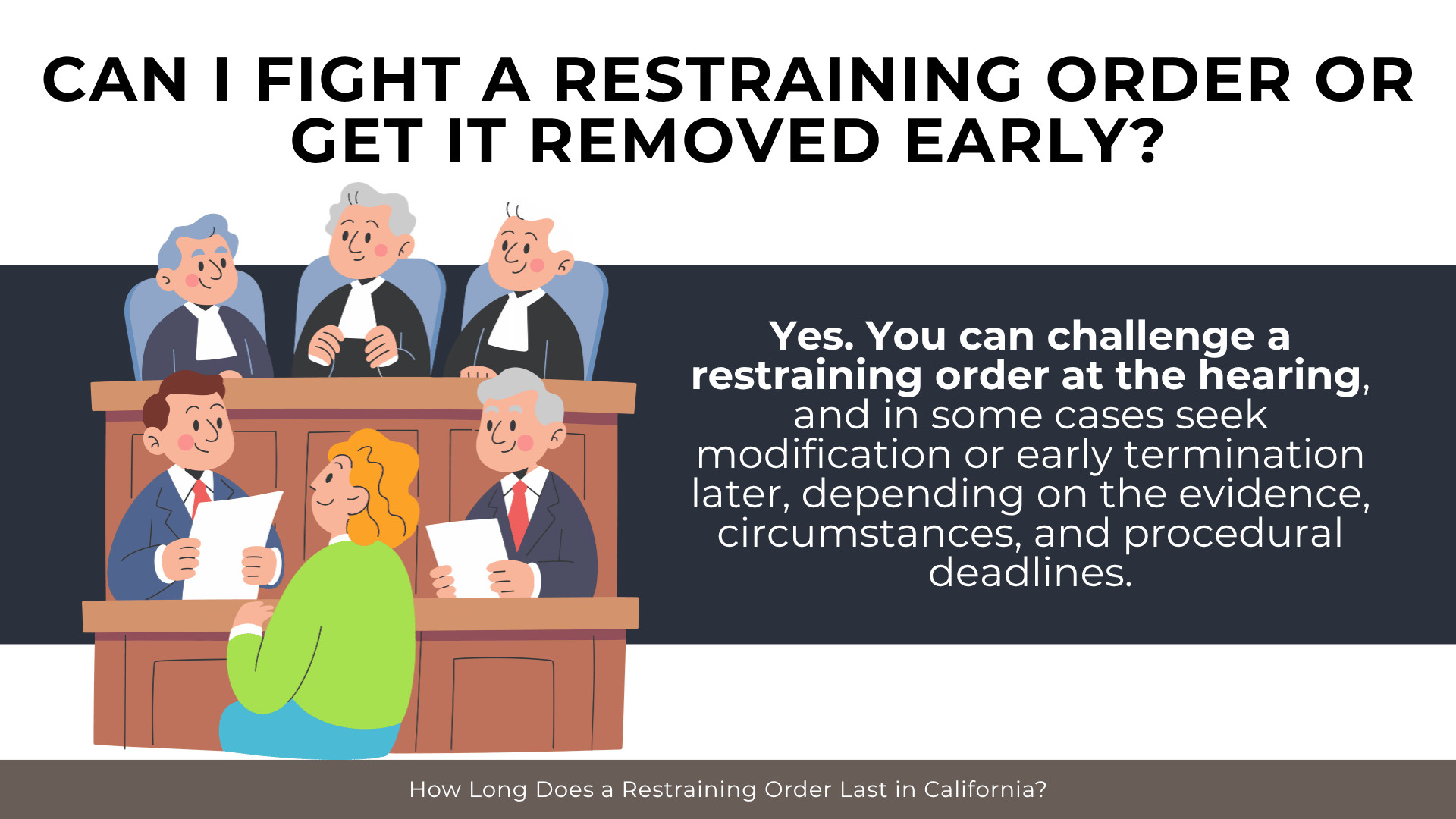
Can I Fight a Restraining Order or Get It Removed Early?
At nearly every stage of the process, there is a legal option that affects how long a restraining order lasts. But those options have deadlines, and they require someone who knows how to use them.
The most important opportunity is the DVRO hearing itself — the noticed hearing that typically takes place 20 to 25 days after a TRO is issued. This is where you can present evidence, cross-examine witnesses, and argue that the petitioner has not met the preponderance-of-the-evidence standard. If the court finds the evidence insufficient, the TRO expires and no long-term order is issued. If the order is granted, you’ve lost the most favorable chance to prevent years of restrictions.
California law also limits the issuing of mutual restraining orders. Under Family Code § 6305(a), a court cannot issue a mutual order unless both parties personally appear, each presents written evidence of abuse in a mandatory Judicial Council form, and the court makes detailed findings that both parties acted primarily as aggressors and that neither acted primarily in self-defense. This matters because it means the other party cannot obtain mutual restrictions against you through a shortcut — they have to meet the same evidentiary burden you’d have to meet.
Even after a DVRO has been issued, modification or termination may be possible depending on changed circumstances. And for CPOs issued in criminal cases, the outcome of the criminal case itself — whether charges are reduced, dismissed, or resolved — can directly affect the duration and scope of the order.
What matters most is this: a restraining order’s duration is not purely a calendar question. It is shaped by what happens at hearings, what evidence is presented, and whether you take an active role in the legal process or let deadlines pass without responding.
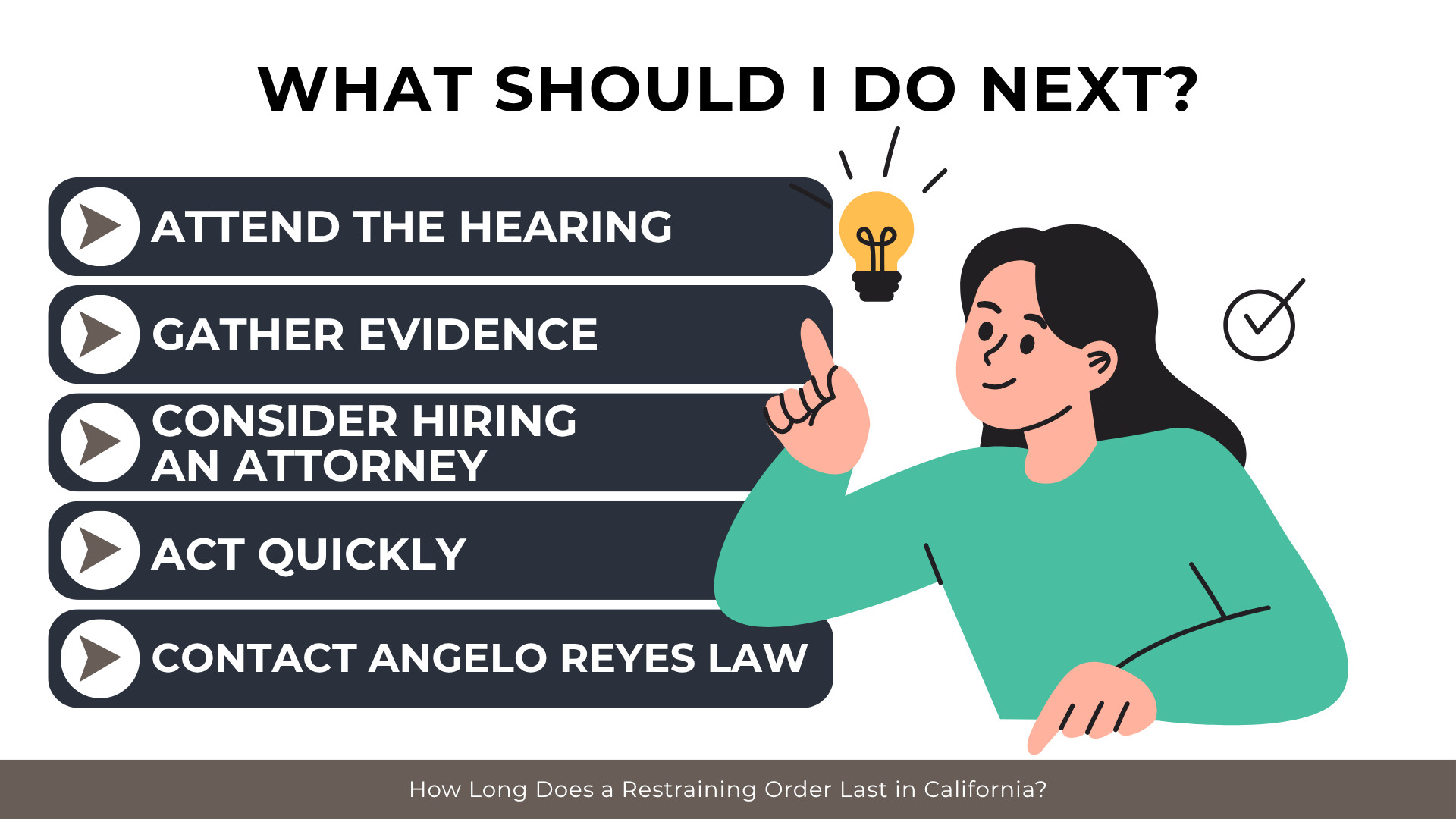
What Should I Do Next?
The answer to “how long does a restraining order last in California” is not a single number. It is a range — from days to permanently — that depends on the type of order, whether and how you respond at each legal stage, and whether you have an attorney advocating on your behalf at the moments that matter most.
The hearing on a Temporary Restraining Order is where most restraining order timelines get decided. That hearing determines whether restrictions last a few weeks or up to five years. The record created at that hearing can support renewals for decades. Showing up prepared, with counsel, with evidence, and with a clear legal strategy is the single most important thing you can do to influence how long a restraining order affects your life.
At Angelo Reyes Law in Carlsbad, California, every case is prepared as if it’s going to jury trial, to build leverage whether the matter resolves through negotiation or at trial. Attorney Angelo Reyes works directly with clients, not through a paralegal or associate, and brings that same trial-first preparation to restraining order defense in San Diego County. If you’re facing a restraining order and need to understand your options, contact Angelo Reyes Law for a consultation.