Domestic violence probation in California is not standard probation. When a court grants probation for any offense involving a victim who qualifies under California Family Code § 6211, Penal Code § 1203.097 requires a specific package of mandatory conditions. These include a minimum three-year probation term, completion of a year-long batterer’s intervention program or counseling session designated by the court, fines, restitution, a criminal protective order, and community service. These conditions apply whether the charge is a misdemeanor or a felony, and the court has no discretion to waive them.
What follows covers the duration, the required conditions, how the batterer’s intervention program works, what the protective order means in practice, firearms restrictions, the consequences of a violation, and whether probation can end early.
How long does domestic violence probation last?
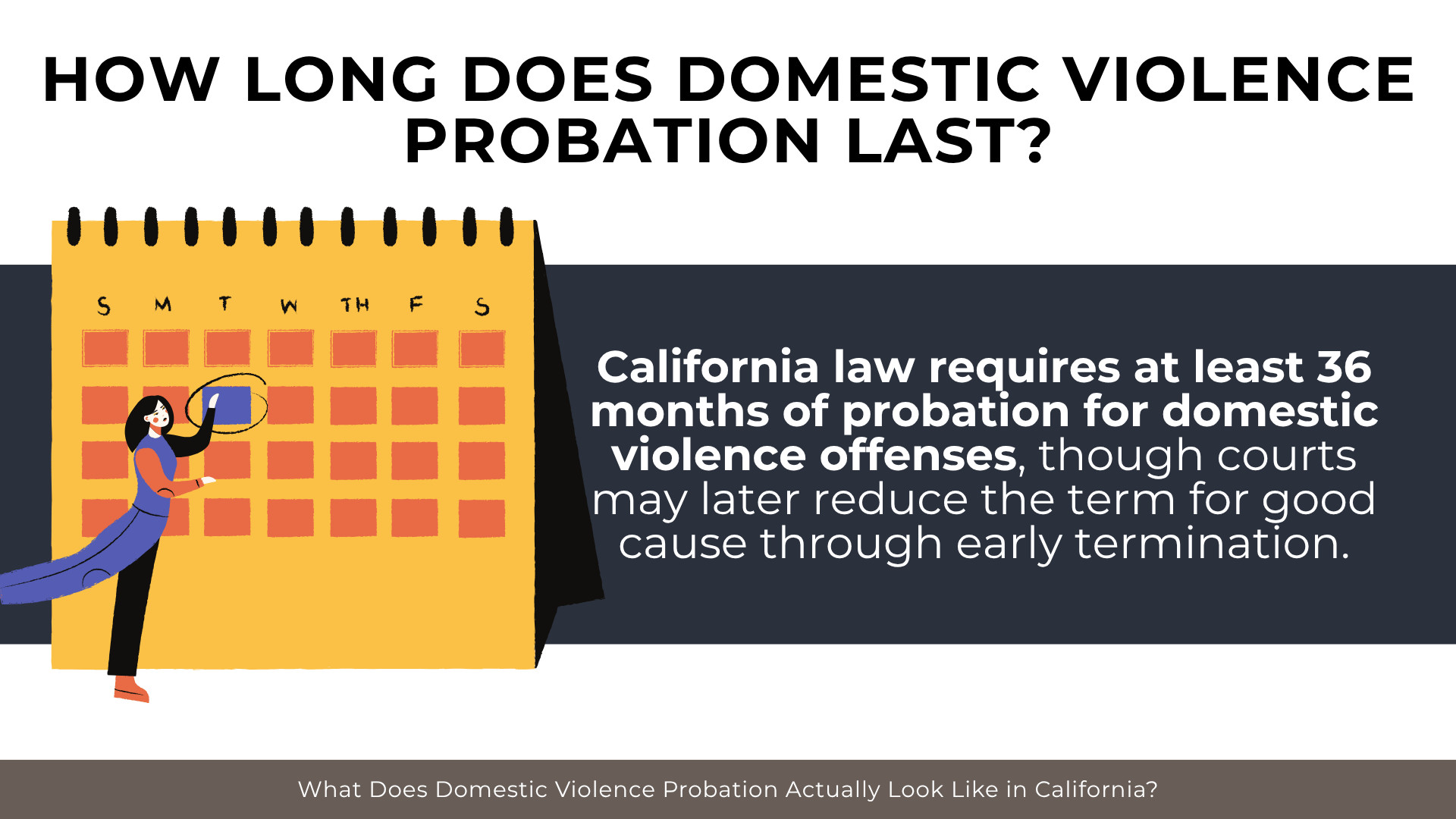
The legal minimum is 36 months. Under Penal Code § 1203.097, any probation term for a domestic violence offense must run at least three years. The statute notes this may include a period of summary (informal) probation as appropriate. Three years is the minimum, and judges can impose longer terms.
That said, 36 months is not necessarily a locked-in number. In People v. Killion (2018), a California appellate court held that the 36-month floor applies to when probation is first imposed. It does not prevent a court from later exercising its discretion under Penal Code § 1203.3 to reduce the term upon a showing of good cause. Early termination is explored in more detail later in this article. The short version is that it exists as a possibility — it just requires the right circumstances.
What conditions will the court require me to follow?
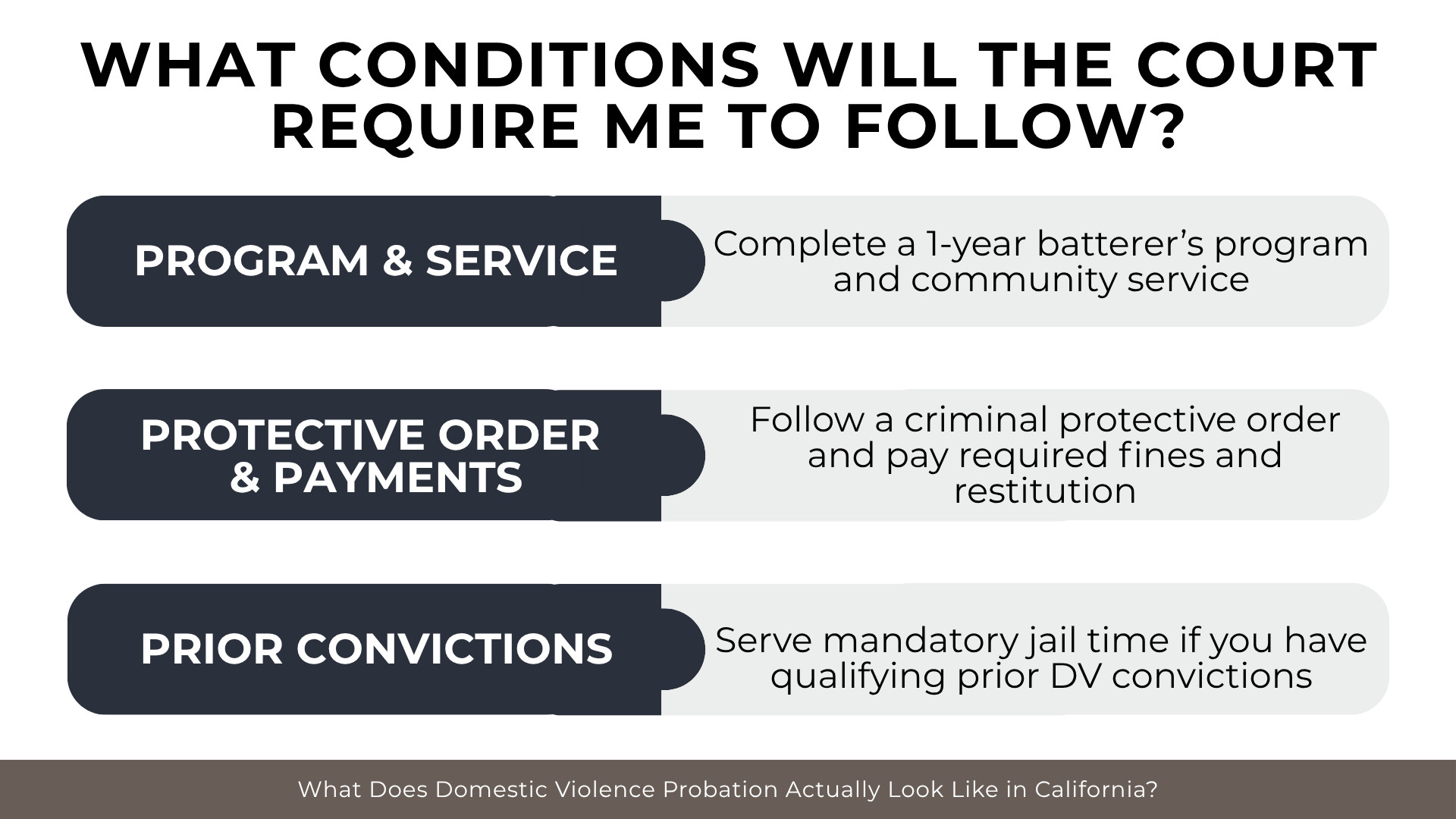
Penal Code § 1203.097 sets out a list of conditions that must be imposed when probation is granted in a domestic violence case. These are not suggestions the court can select from. They are mandatory, and they include the following.
The court must order enrollment in and completion of a batterer’s intervention program or counseling session designated by the court, lasting at least one year, with weekly sessions of at least two hours. A criminal protective order must be issued. You must pay a minimum fine of $500, directed to domestic violence programs, in addition to victim restitution. The statute specifies that community property cannot be used to satisfy your restitution obligation. Community service is required. You must be booked within one week of sentencing if you have not already been booked. And the victim must be notified of the outcome of the case.
If you have prior domestic violence convictions, additional mandatory jail time applies even when probation is granted. Under Penal Code § 273.5(h), one prior DV conviction within seven years triggers a mandatory minimum of 15 days in county jail. Two or more priors within that window raises the floor to 60 days.
Each of these conditions carries its own deadlines and reporting requirements. The batterer’s intervention program and the protective order tend to generate the most questions, so they are addressed separately below.
What is the batterer’s intervention program, and how does it work?
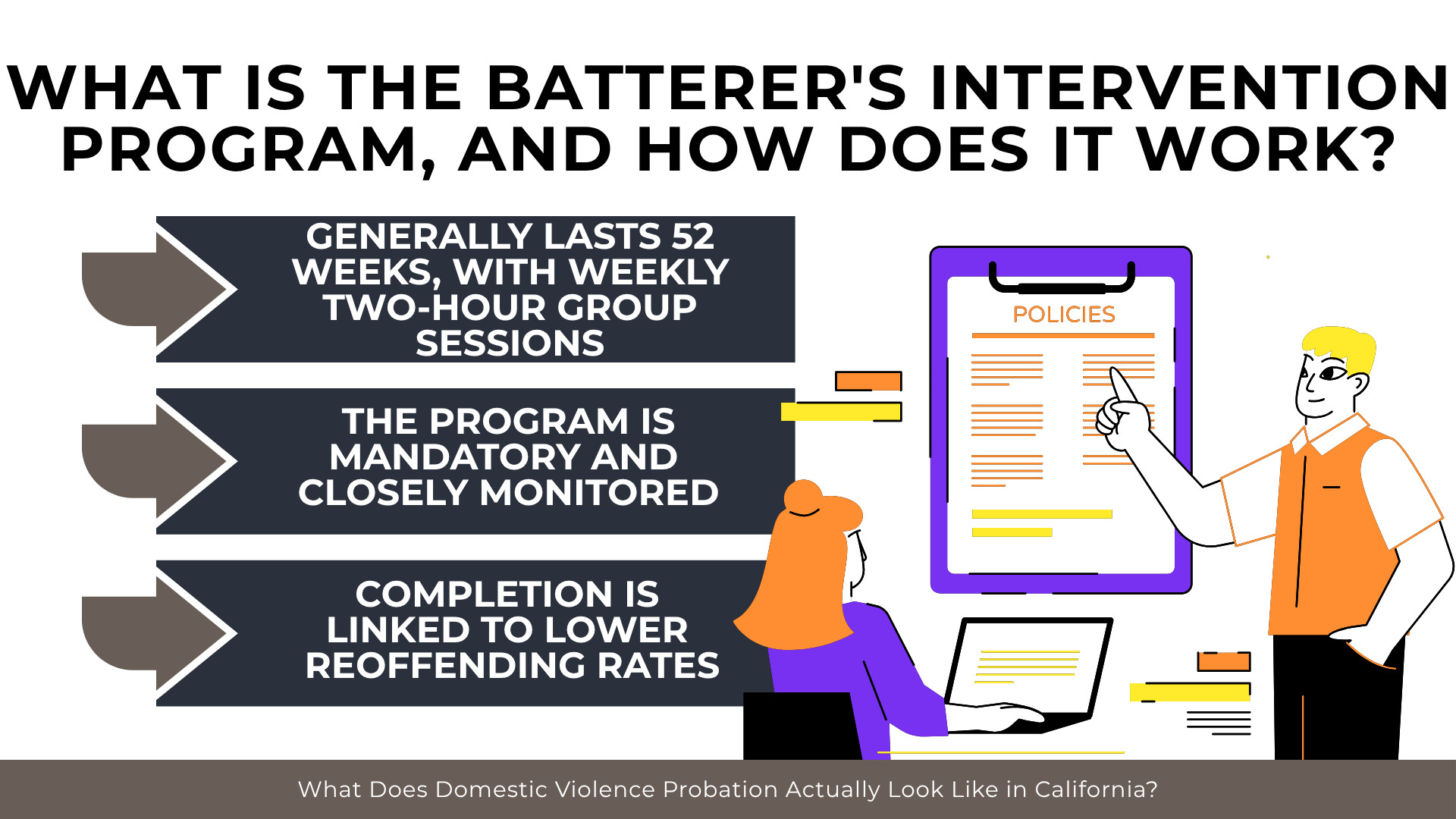
The batterer’s intervention program — often called a BIP or sometimes a “52-week program” — is the most time-consuming condition of domestic violence probation. Under Penal Code § 1203.097, the program or counseling session designated by the court must last at least one year. Sessions must be held weekly and run at least two hours each. They are conducted in a same-gender group format, and the program is required to submit quarterly progress reports to the court.
The program is not optional, and it is not a formality. A California State Auditor investigation of six counties found that 46 out of every 100 domestic violence offenders did not complete the mandated program. Of those who failed, some never enrolled, others were terminated by programs, and many simply dropped out. The same audit found that among non-completers, 65 percent went on to reoffend for domestic violence or abuse-related crimes, compared to 20 percent of those who finished — a threefold difference in reoffending.
In practice, BIP compliance requires a steady weekly commitment for a full year. Missed sessions, failure to enroll on time, or removal from a program by the provider can all be reported to the court and treated as a probation violation.
Will there be a protective order, and what does it mean for my daily life?
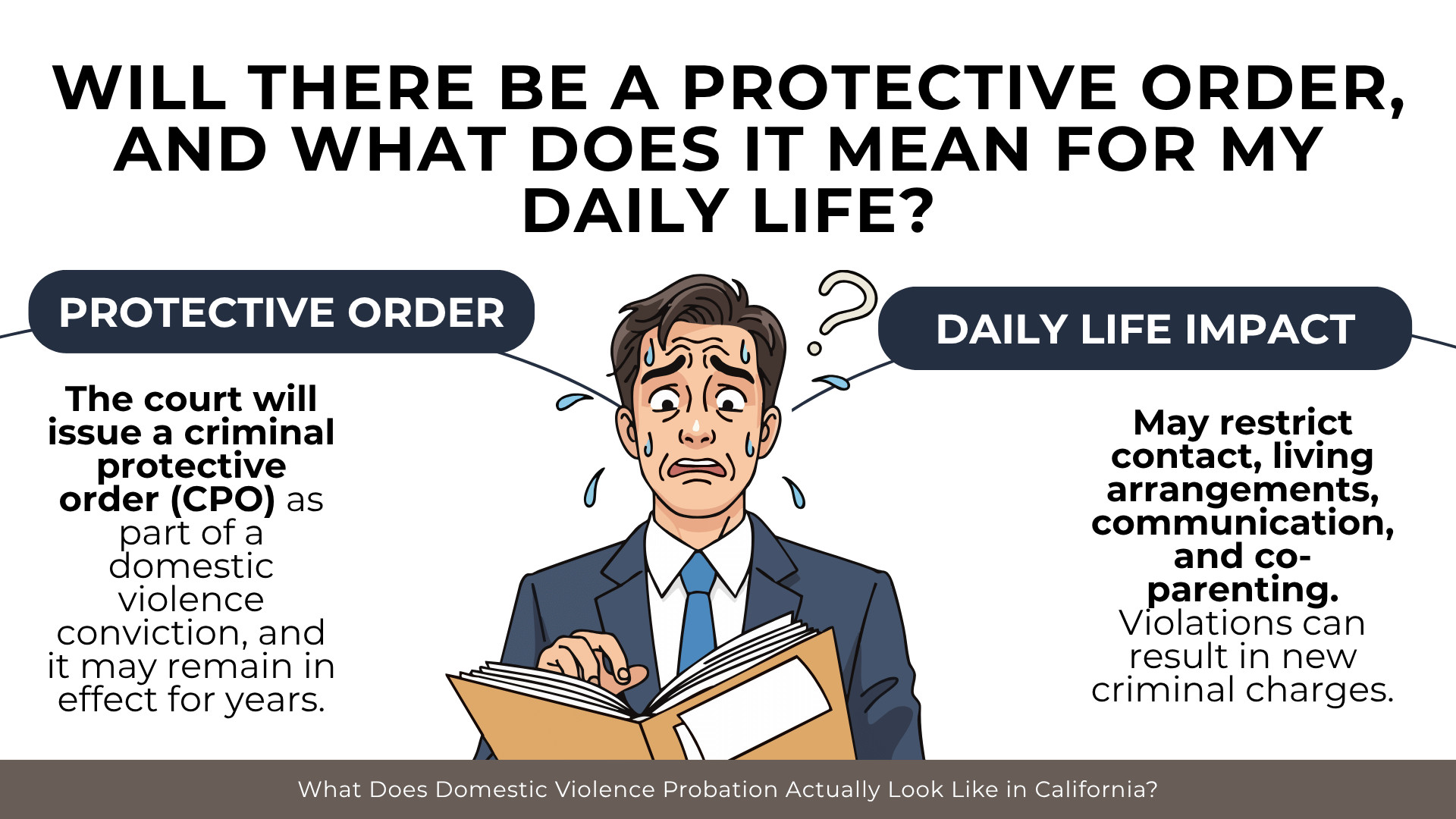
Yes. A criminal protective order under Penal Code § 136.2 is a mandatory condition of domestic violence probation. The court must issue one at sentencing, and it can remain in effect for a long time after the case concludes. For most DV convictions, the post-conviction CPO can last up to 10 years as determined by the court. For convictions under Penal Code § 273.5 — corporal injury to a spouse or cohabitant — the maximum extends to 15 years.
The specific terms of the CPO are set by the court and vary by case. If you share a home or children with the protected person, the order raises immediate practical questions about shared housing, co-parenting logistics, and what kind of contact — if any — is permitted. An attorney can help clarify what a specific order allows and prohibits.
It is worth understanding that a criminal protective order issued in the DV case takes precedence over most civil court orders while the criminal case is open, with the narrow exception of emergency protective orders. If there is a separate family court case involving custody or visitation, the CPO controls where there is a conflict. A violation of the CPO’s terms can be charged as a separate crime under Penal Code § 166(c)(1). That means a single instance of prohibited contact can generate a new criminal charge on top of a probation violation.
Do I have to give up my firearms during probation?
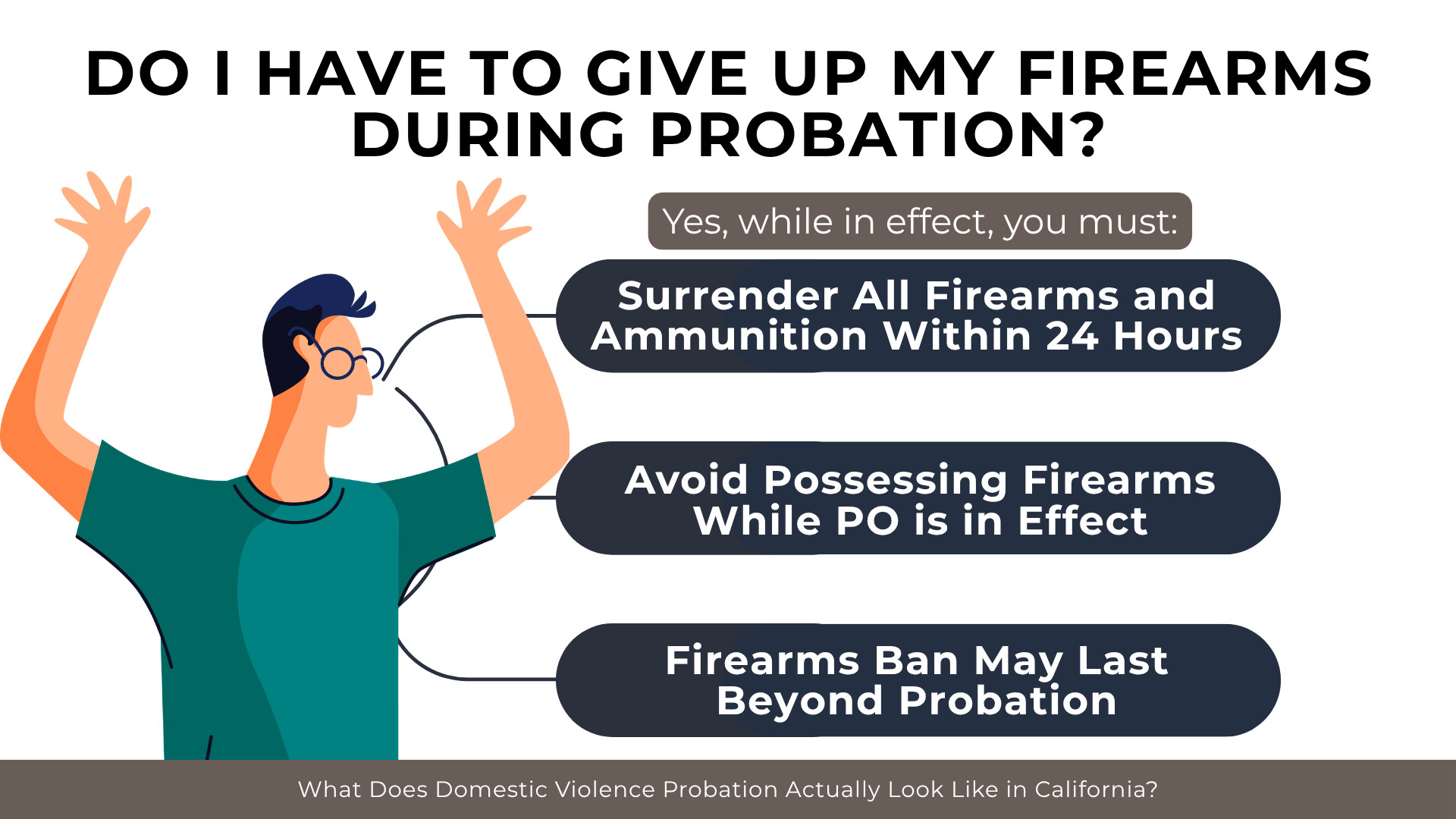
Yes, and the restriction begins quickly. Under Penal Code § 136.2(d), when a criminal protective order is issued in a domestic violence case, you must surrender all firearms and ammunition within 24 hours of being served. Proof of compliance — including a copy of the receipt if applicable — must be filed with the court within 48 hours, along with filing with the law enforcement agency that served the protective order. Surrender can be made to local law enforcement or to a licensed firearms dealer through sale, transfer, or storage.
California Penal Code § 29825 makes it a wobbler offense to possess a firearm while subject to a qualifying protective order, including both DVROs and criminal protective orders. At the state level, this prohibition covers ex parte and temporary orders. That is a broader reach than federal law, which requires a post-hearing order to trigger the firearms bar under 18 U.S.C. § 922(g)(8).
What makes the firearms issue especially serious is that the restriction can outlast probation itself. A conviction for a misdemeanor crime of domestic violence triggers a separate, permanent federal firearms prohibition under 18 U.S.C. § 922(g)(9), known as the Lautenberg Amendment. This is a lifetime ban with no federal restoration process and no exception for law enforcement or military personnel. Importantly, California’s expungement under Penal Code § 1203.4 does not remove the federal firearms ban, because the statute explicitly does not restore firearms rights. The realistic paths to restoration are narrow: a full and unconditional governor’s or presidential pardon, administrative relief from the ATF, or in limited circumstances, court-based relief under a specific state program.
What happens if I violate a condition of probation?
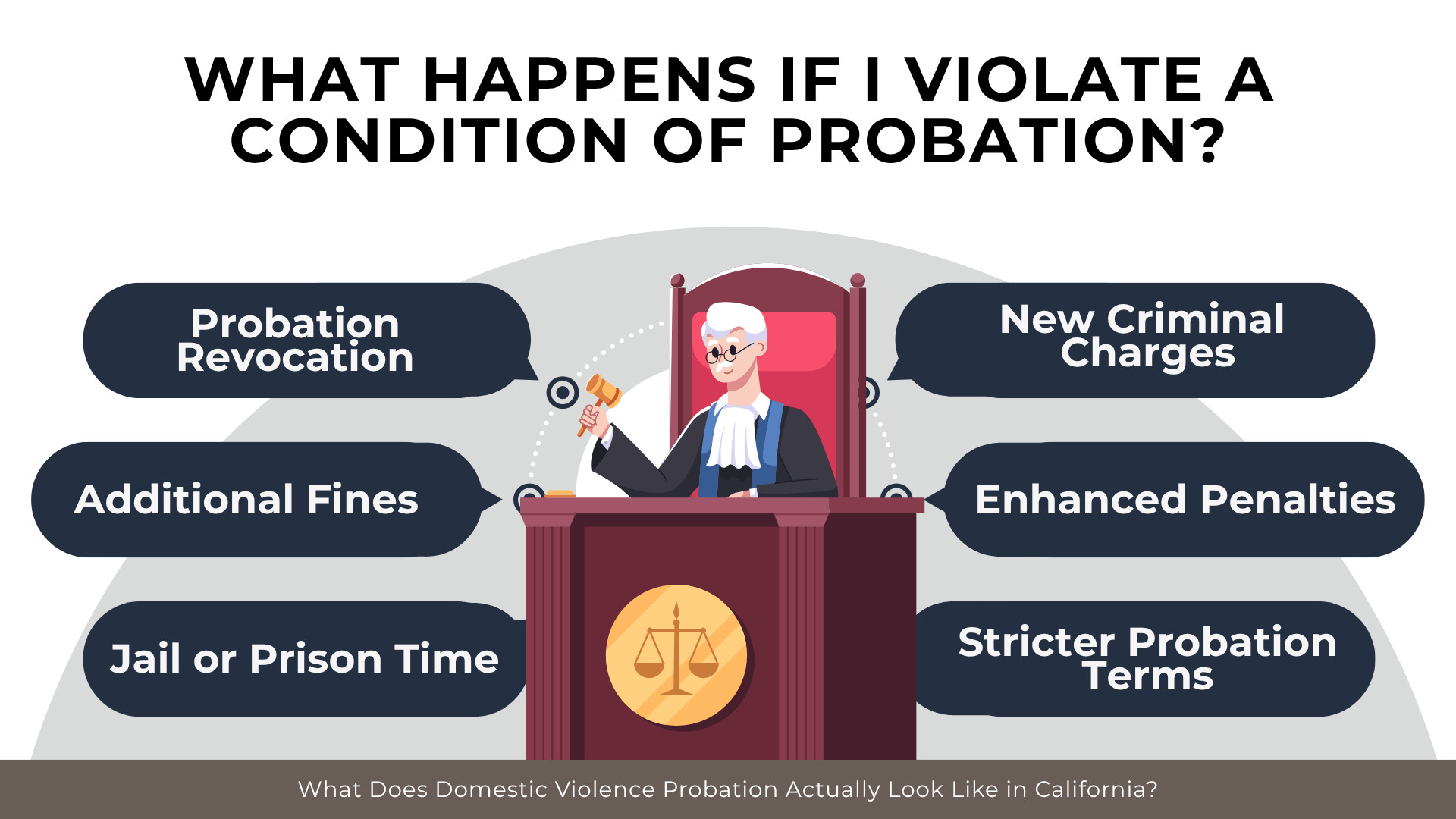
The consequences of a probation violation in a domestic violence case can be severe. The specific outcome depends on the nature of the violation and the court’s assessment. But violations put you at risk of additional penalties up to and including incarceration.
The most common violations involve the batterer’s intervention program: failing to enroll on time, missing sessions, or being dropped by the program provider. The California State Auditor found that courts imposed consequences for only about 9 percent of known BIP-related violations across the counties it audited. That is a significant gap between what the law allows and how consistently it is enforced. But inconsistent enforcement is not the same as no enforcement. A court that learns of a violation still has the authority to act, and some judges treat noncompliance seriously from the first reported instance.
Violations involving the criminal protective order carry added risk. Contact with the protected person that violates the order’s terms can result in a new criminal charge under Penal Code § 166(c)(1), separate from and in addition to any probation revocation proceedings. A new arrest while on DV probation also exposes you to the mandatory minimum jail provisions under Penal Code § 273.5(h) if the new offense is itself a DV charge. That is because your original conviction now counts as a prior.
The bottom line is that every condition of probation functions as a tripwire. Some are enforced more aggressively than others, but none is safe to ignore.
Can I get off probation early?
It is possible, though it is not guaranteed. In People v. Killion (2018), a California appellate court held that the 36-month minimum probation period under Penal Code § 1203.097 applies to when probation is first imposed. It does not bar the court from exercising its discretion under Penal Code § 1203.3 to modify or terminate probation early upon a showing of good cause.
What counts as good cause is not defined by a checklist, but courts generally look at whether you have completed the batterer’s intervention program, complied with all probation conditions including the protective order and restitution, avoided any new criminal conduct, and shown that continued supervision is no longer necessary. A motion for early termination is far more likely to succeed when the record reflects full, consistent compliance. That means not just the absence of violations, but full completion of every required program and payment.
This is one of the areas where the distinction between going through the motions and genuinely completing every condition matters. If you finish BIP, pay all fines and restitution, complete community service, and maintain a clean record during the probation period, you are building the record a court would need to grant early termination. If you have outstanding obligations or a history of late compliance, you are not.
How can an attorney help me before, during, or after probation?
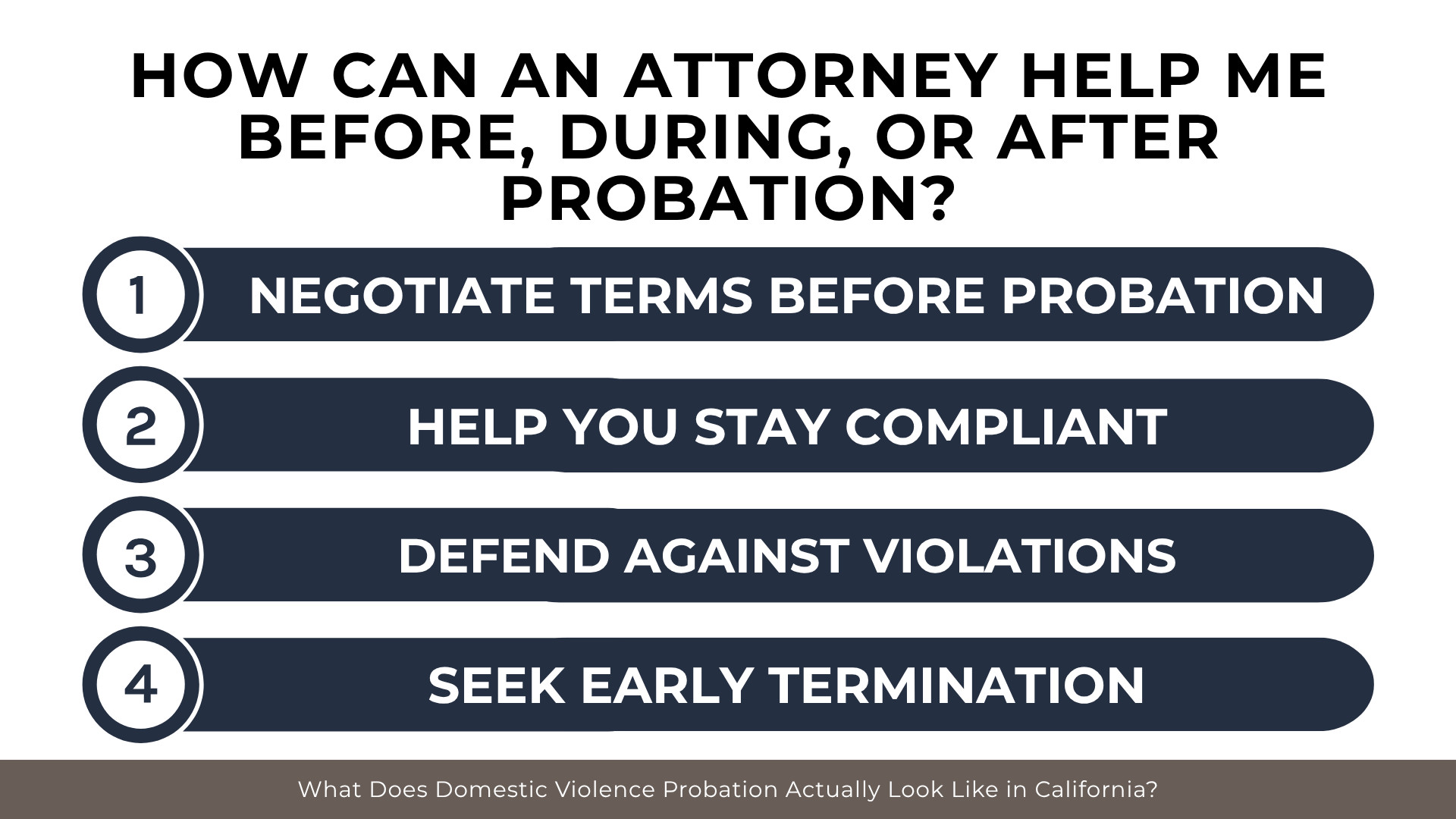
Domestic violence probation touches nearly every part of your life — housing, family relationships, employment, constitutional rights. The conditions are mandatory, the timeline is long, and the margin for error is narrow. An attorney’s role is not limited to the courtroom at sentencing.
Before probation is imposed, there may be opportunities to negotiate terms, argue for specific conditions, or pursue alternatives to a conviction that would avoid triggering the mandatory probation requirements entirely. During probation, an attorney can intervene when compliance issues come up — a program conflict, a question about the protective order, a change in circumstances that requires a court modification — before those issues become formal violations. After sufficient compliance, an attorney can file a motion for early termination under the rule from People v. Killion, supported by the record of completed conditions.
At Angelo Reyes Law in Carlsbad, California, every case is prepared with the same rigor whether it resolves through negotiation or goes to trial. That approach matters in domestic violence cases, where the quality of advocacy at sentencing directly shapes what probation looks like — and where the work of protecting a client’s future often continues long after the case is formally resolved. If you are facing a domestic violence charge where probation is a likely outcome, or if you are already on probation and need help navigating a violation, a modification, or early termination, you can contact Angelo Reyes Law to discuss your situation.