A domestic violence no contact order in California can last anywhere from five days to fifteen years — and in some cases, it can be renewed permanently. The duration depends almost entirely on what type of order was issued, what stage of the legal process you’re in, and whether the order came from a criminal court or a civil court.
That range is wide enough to be frustrating when what you need is a specific answer. This page breaks down each type of no contact order California courts issue in domestic violence cases, how long each one lasts, and whether it can be modified or removed early.
What kind of no contact order are you dealing with?
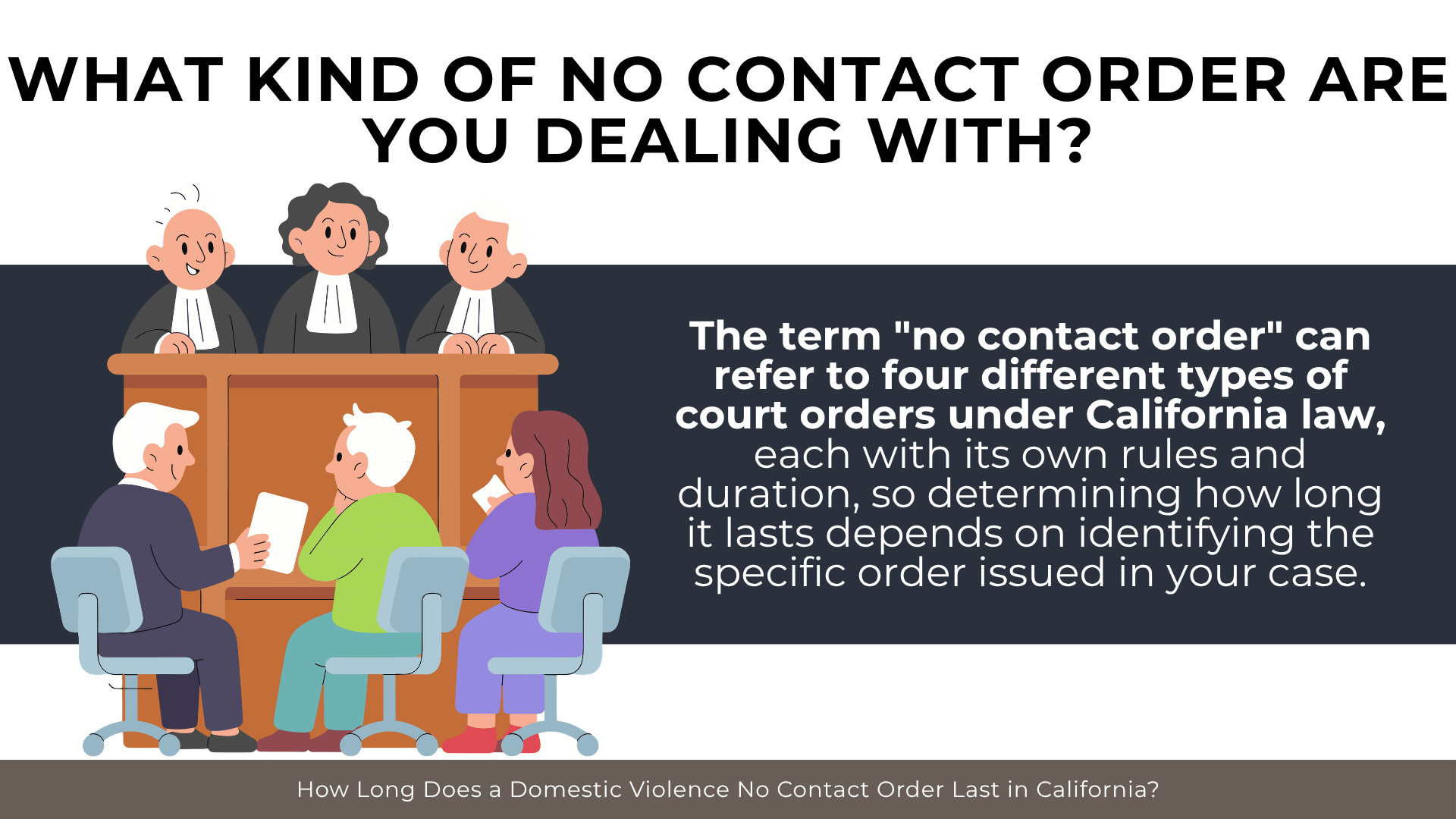
California does not have a single “no contact order.” The term gets used loosely. It can actually refer to any of four distinct court orders, each governed by a different statute, issued under different circumstances, and with a different time limit. The four are an emergency protective order, a temporary restraining order, a domestic violence restraining order, and a criminal protective order. Some are filed by the alleged victim through civil court. Others are imposed by a criminal court judge at arraignment or sentencing — sometimes without anyone requesting them.
Before you can answer the duration question, you need to identify which order you’re actually subject to. The paperwork itself will usually indicate whether it was issued under the Family Code or the Penal Code. If you’re unsure, a criminal defense attorney can review the order and tell you exactly what you’re dealing with, what restrictions it carries, and how long it remains in effect.
How long does an emergency protective order last?
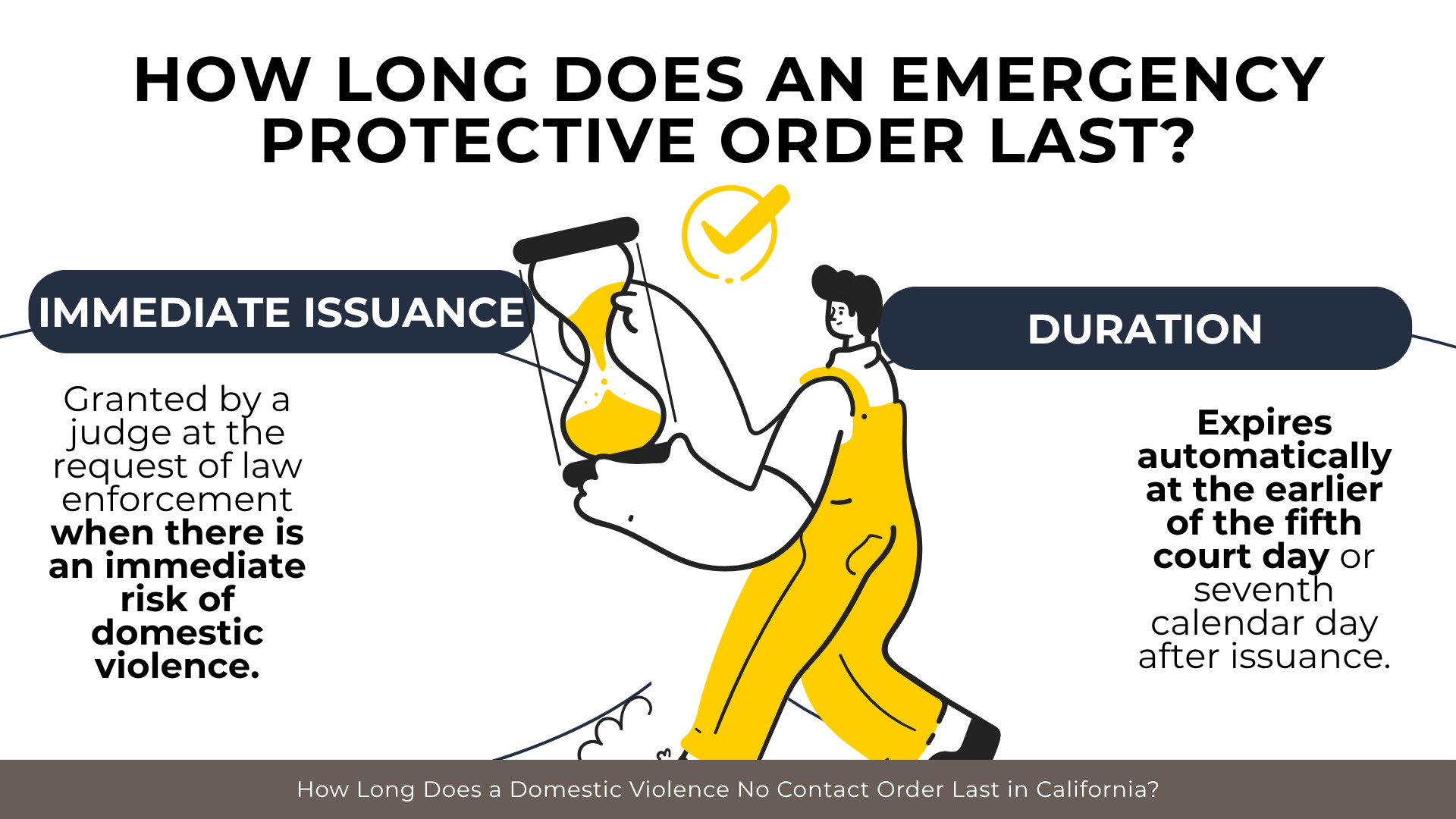
An emergency protective order is the shortest-lived of the four. Under California Family Code § 6250, an EPO is issued by a judge at the request of a law enforcement officer. The officer must state reasonable grounds to believe that an immediate and present danger of domestic violence exists under § 6251(a). You have no opportunity to be heard before it takes effect. It is issued on the spot, often the same night law enforcement responds to a call.
An EPO expires at the earlier of two points: the close of business on the fifth court day after issuance, or the seventh calendar day — whichever comes first. That timeline is set by Family Code § 6256 and cannot be extended. The order simply expires. However, those five to seven days are often used by the other party to file for a longer-lasting restraining order. An EPO may feel temporary, but it can be the first step toward something that lasts significantly longer.
One important detail: only law enforcement can request an EPO. The protected party cannot obtain one directly. And while it is in effect, an EPO overrides all other protective orders under Penal Code § 136.2(c)(1)(A), provided it meets certain specific requirements.
How long does a temporary restraining order last?
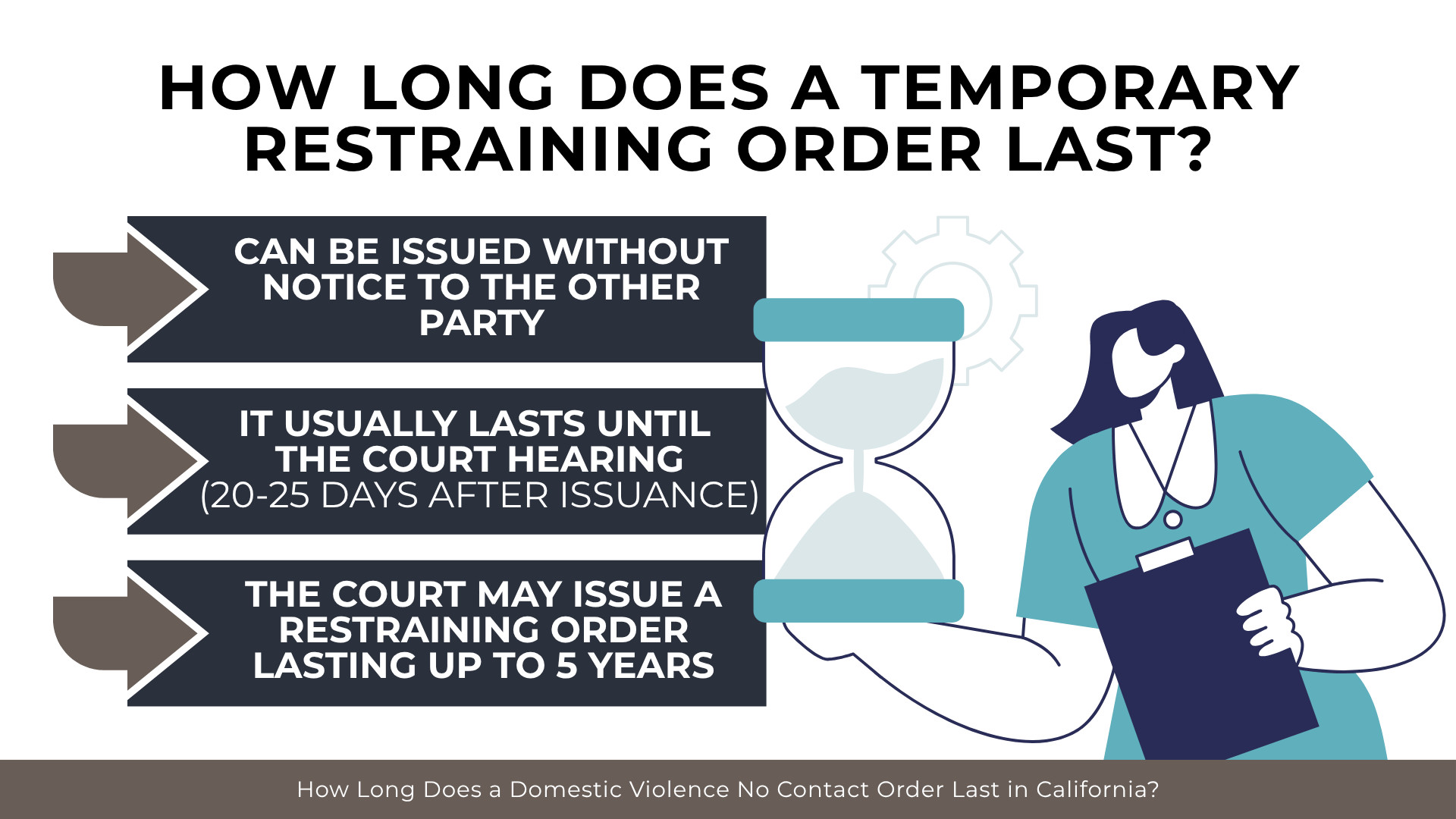
A temporary restraining order under Family Code § 6300 is a civil order, typically filed by the person seeking protection. It can be issued without notice to you. The statute specifically says under § 6300(b) that it “shall not be denied solely because the other party was not provided with notice.” That means you may first learn about a TRO when you are served with it.
A TRO lasts until the court holds a noticed hearing, which is typically scheduled 20 to 25 calendar days after the order is granted. The TRO is not a final order. It is a bridge — designed to maintain protection while the court schedules a hearing where both sides can appear, present evidence, and argue whether a longer-term order should be issued. If the court denies the TRO at any point before the hearing, it must state its reasons under Family Code § 6320.5.
The hearing is where the duration question gets decided in earnest. If the court finds reasonable proof of a past act of abuse by a preponderance of the evidence, it can issue a domestic violence restraining order lasting up to five years.
How long does a criminal protective order last during a pending case?
If you’ve been arrested or charged with a domestic violence offense, the order you’re most likely dealing with is a criminal protective order issued under Penal Code § 136.2. This is not something the alleged victim files for. The court imposes it, typically at arraignment, when there is good cause to believe that harm to, or intimidation or dissuasion of, a victim or witness has occurred or is reasonably likely to occur.
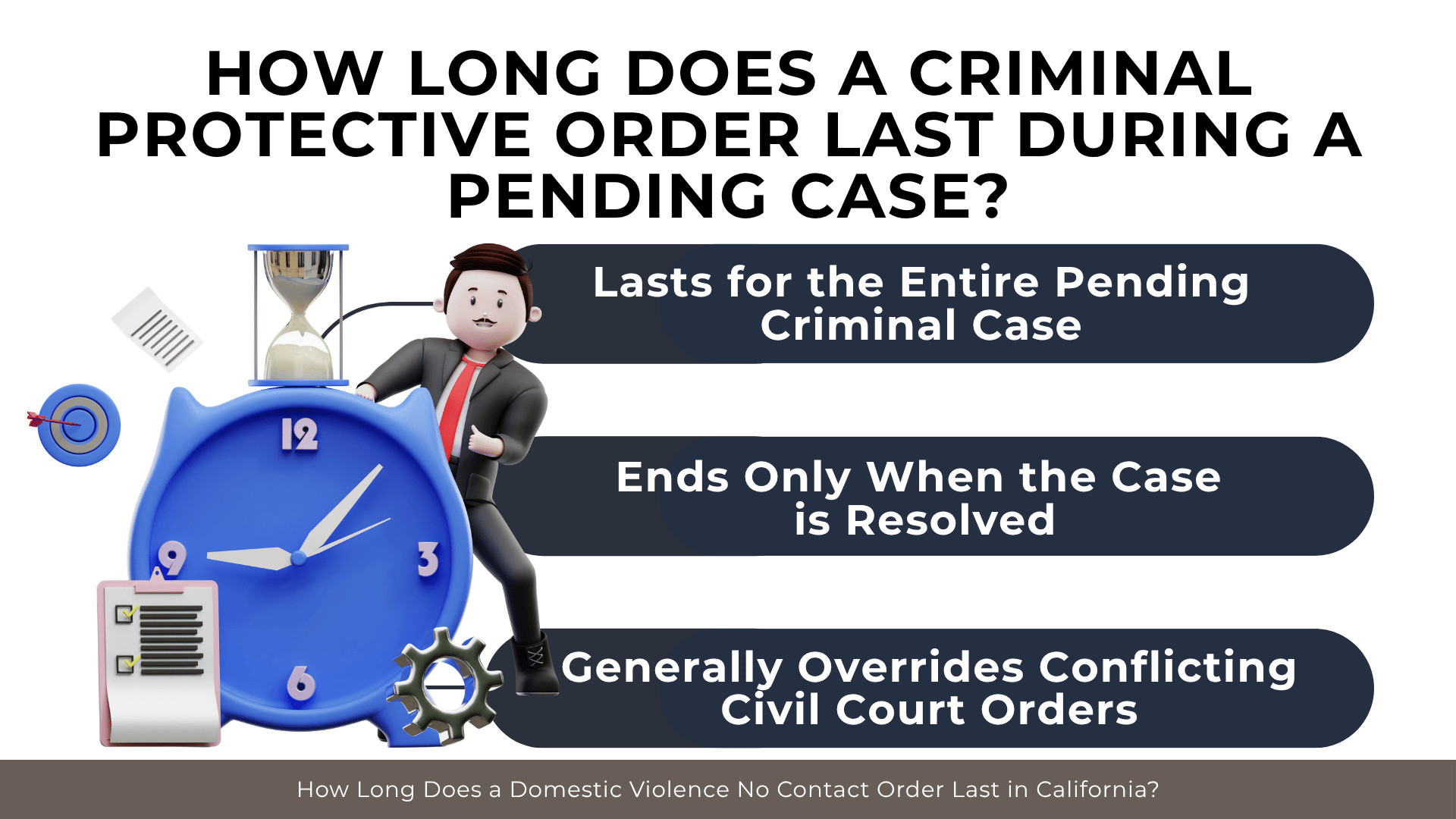
A pre-conviction criminal protective order remains in effect for the entire duration of the criminal case. There is no fixed expiration date on the calendar. It lasts until the case reaches a resolution — whether that’s a dismissal, an acquittal, or a conviction and sentencing. If the case takes three months to resolve, the order lasts three months. If the case takes a year or longer, the order lasts that long too.
During this period, the criminal protective order overrides any existing civil court orders under Penal Code § 136.2(e)(2). The one exception is an active EPO, which still takes priority under § 136.2(c)(1)(B). This means that even if a family court has issued a custody or visitation arrangement, the criminal court’s no contact order can override it for as long as the case is pending.
In a Bureau of Justice Statistics study of large urban counties, protection orders were issued against 47% of domestic violence aggravated assault defendants granted pretrial release. It is not unusual, and it does not mean the order will be in place forever. But every day the case remains open is a day the order remains enforceable.
How long does a no contact order last after a conviction?
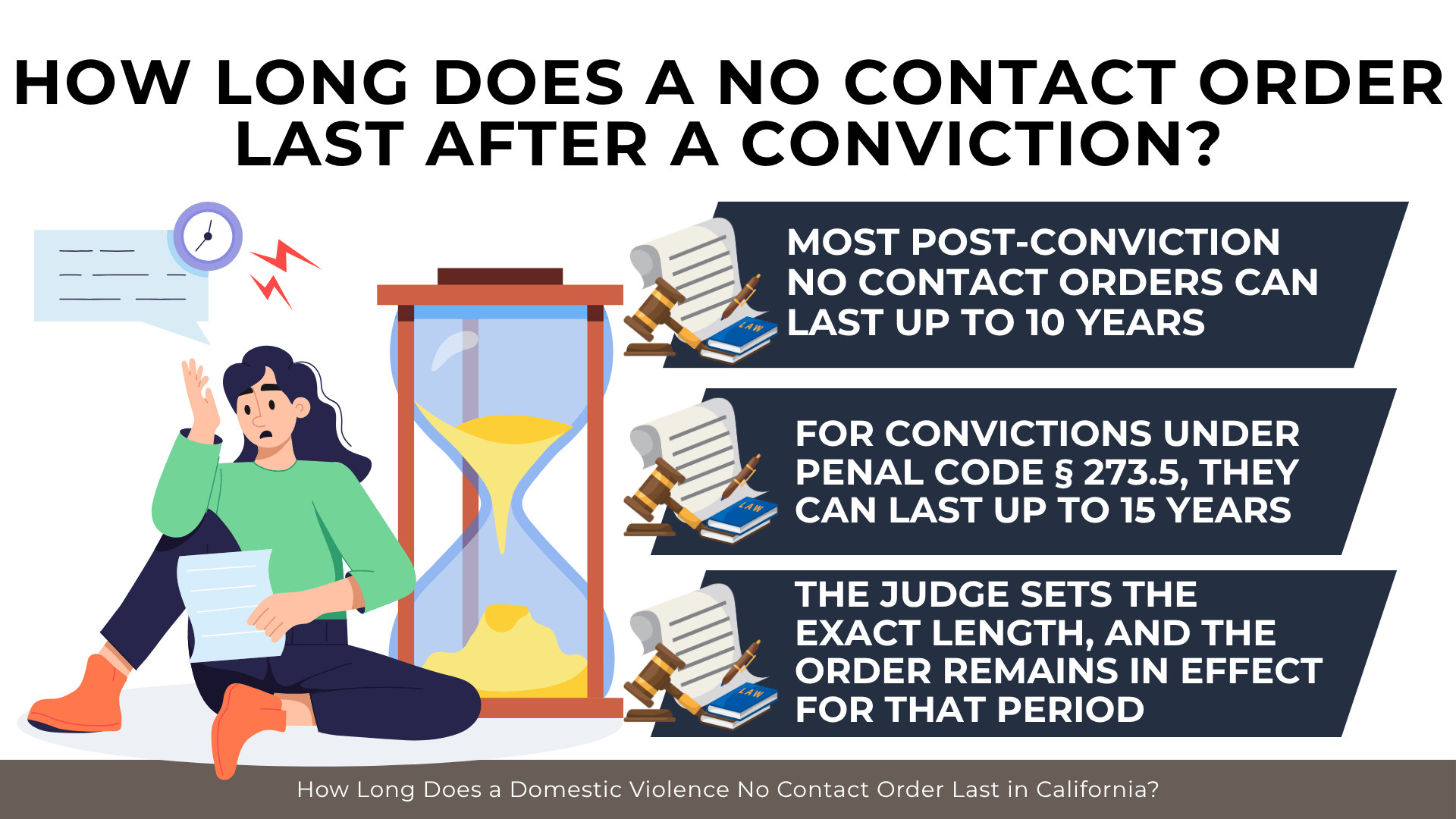
A conviction changes the timeline significantly. Under Penal Code § 136.2(i)(1), a court can impose a post-conviction criminal protective order lasting up to ten years. For convictions involving willful infliction of corporal injury under Penal Code § 273.5, the maximum extends to fifteen years under § 273.5(j).
The court has discretion within those caps. A post-conviction order does not automatically run for ten or fifteen years — the judge determines the duration based on the facts of the case. But the upper limits are substantial. Because the order is tied to a conviction rather than a pending case, it does not expire when probation ends or when a sentence is served. It runs for the period the court sets at sentencing.
This is the scenario that tends to cause the most concern, and for understandable reasons. A ten- or fifteen-year no contact order affects where you live, how you co-parent, and how you interact with people who may be part of your daily life. The length of the order makes the defense strategy before conviction — whether that means fighting the charges, negotiating a reduction, or pursuing a case dismissal — critically important.
How long does a domestic violence restraining order (DVRO) last?
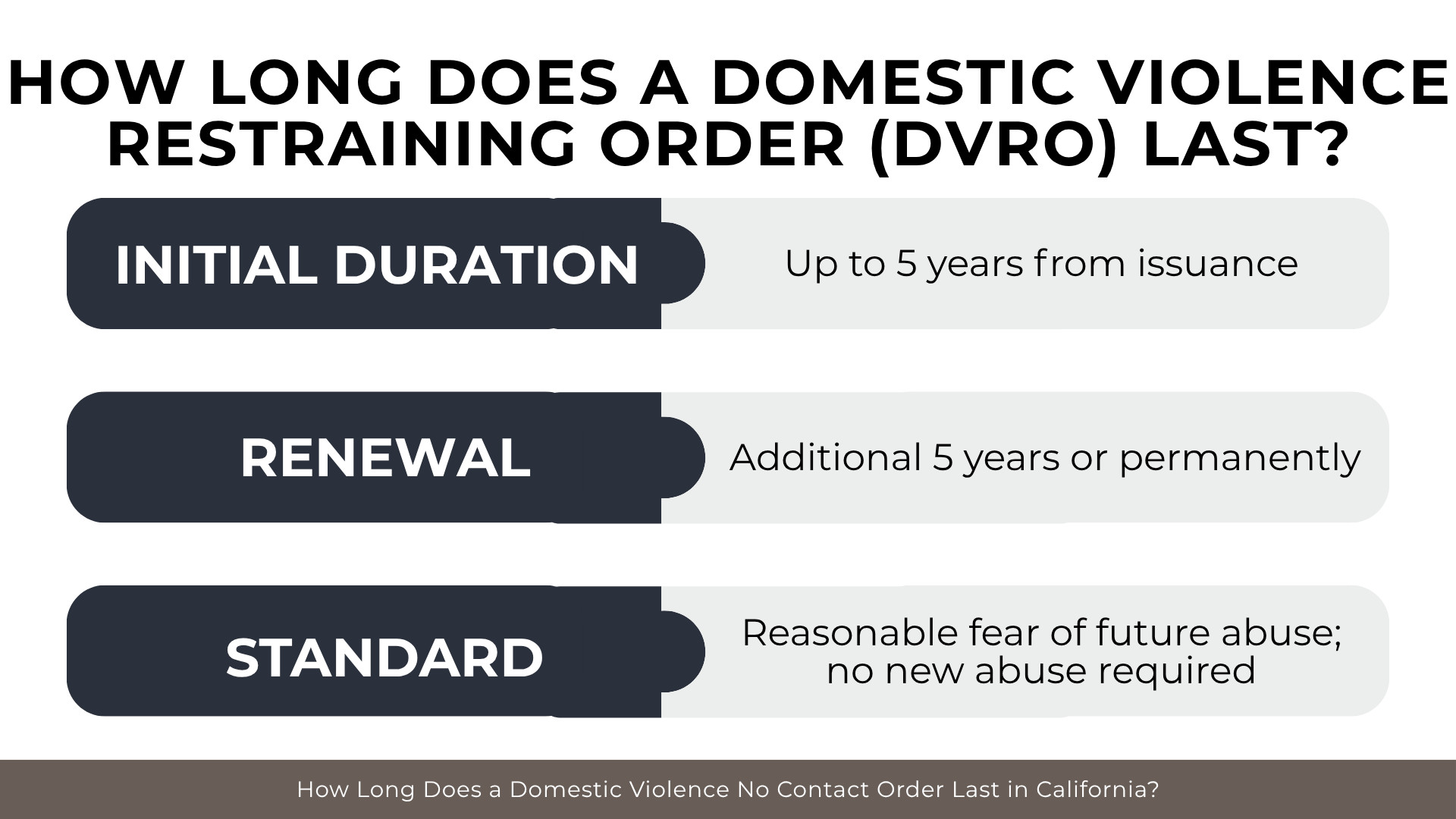
A domestic violence restraining order issued under Family Code § 6300 is a civil order, separate from the criminal case. It can last up to five years from the date of issuance. And under Family Code § 6345(a), it can be renewed for an additional five or more years — or permanently. The protected party does not need to show that any new abuse has occurred since the original order.
The renewal standard was established in Ritchie v. Konrad (115 Cal.App.4th 1275, 2004). The court held that a DVRO should be renewed if the protected party demonstrates a reasonable apprehension of future abuse by a preponderance of the evidence. No new incidents are required. That standard makes DVROs the one category of protective order in California that can become permanent.
A DVRO can also exist alongside a criminal protective order. The two serve different functions. A CPO is issued by the criminal court to protect during or after prosecution. A DVRO is a civil remedy that can address custody, support, property, and residence in addition to contact restrictions. When both are active, the CPO takes priority if they conflict, but the DVRO provides remedies that a criminal court cannot order.
California courts process tens of thousands of DVRO petitions each year, making this one of the most common protective order types in the state.
Can a no contact order be lifted or changed before it expires?
Yes — and this is where the timeline stops being something that happens to you and becomes something you can influence.
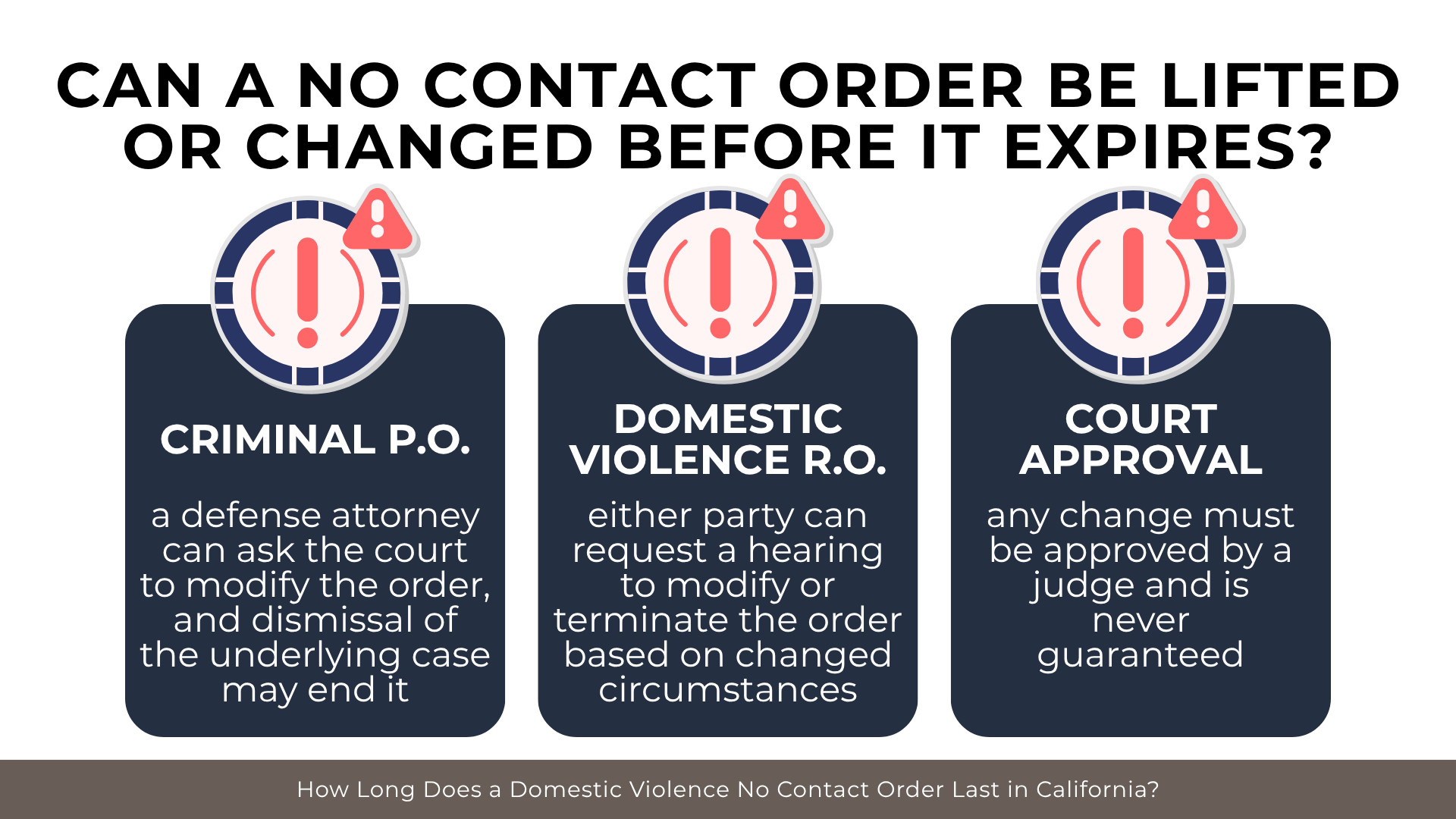
For a criminal protective order issued during a pending case, the defense attorney can file a motion asking the court to modify the order’s terms. Courts consider these requests on a case-by-case basis, and an attorney experienced with protective order proceedings can present the argument for modification.
Because a pre-conviction CPO is tied to a pending criminal case, a dismissal of the underlying case would generally mean the order no longer has a reason to stay in place.
For a DVRO, you can request a hearing to modify or dissolve the order by showing changed circumstances. The protected party can also request modification, including asking the court to terminate the order early.
None of these outcomes are guaranteed, and courts take protective orders seriously. But the point is that the duration printed on the order is a maximum, not a sentence. An attorney who understands how these orders work in practice — and who has experience presenting modification requests to judges — can make a difference in how long the order actually remains in place.
Talk to a Carlsbad Criminal Defense Attorney About Your No Contact Order
The length of a no contact order depends on facts specific to your case — what type of order was issued, what charges are pending, and what stage of the process you’re in. A criminal defense attorney can review your order, explain exactly how long it lasts under current law, and determine whether modification or removal is a realistic option.
At Angelo Reyes Law in Carlsbad, attorney Angelo Reyes works directly with clients facing domestic violence charges across San Diego County. Every case is prepared as though it’s going to trial, which creates leverage whether the matter resolves through negotiation or in front of a jury — and that same approach applies to challenging or modifying the protective orders that come with a DV case. If a no contact order is affecting your daily life, your housing, or your ability to see your children, that’s a conversation worth having now rather than later.